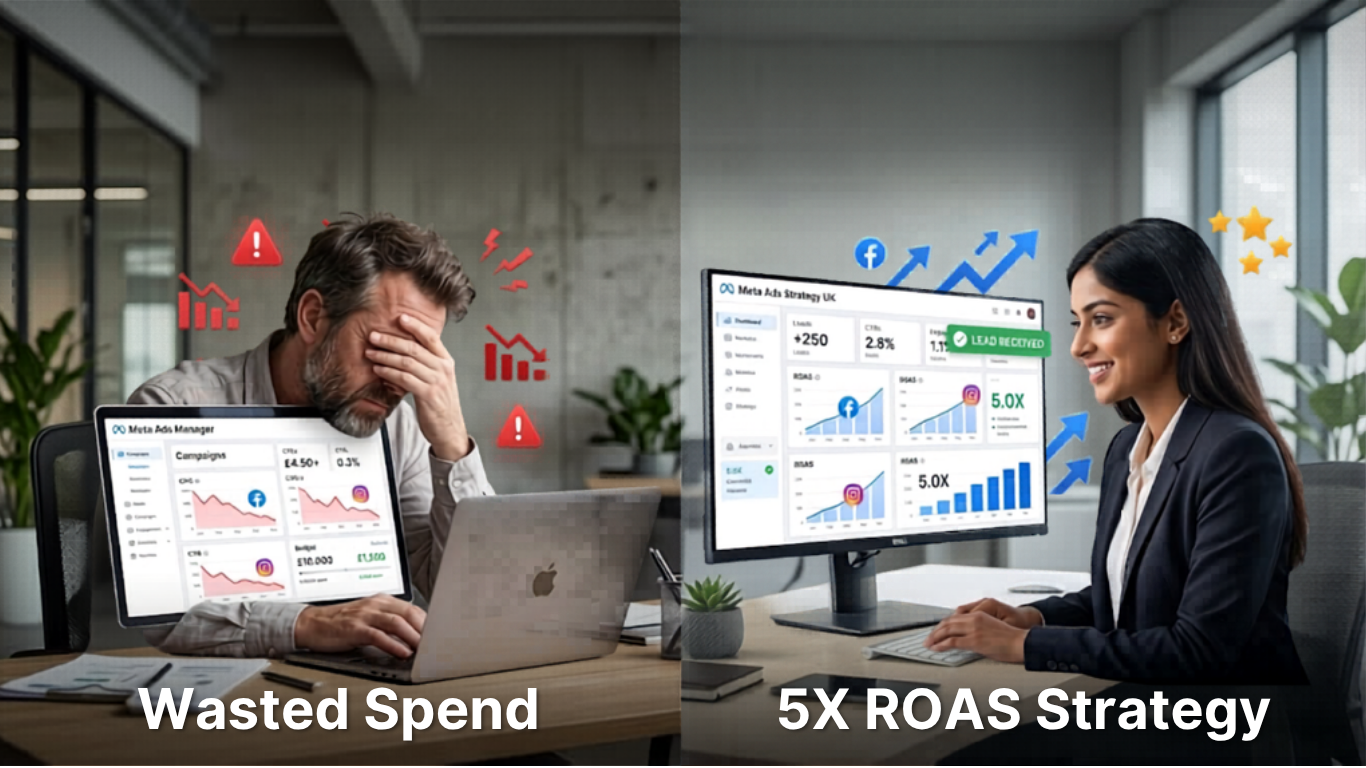
Meta Ads Lead Generation UK: The Strategy That Delivered 5X ROAS
How a real client achieved 5X return on ad spend using Meta Ads in 2026
Introduction: Why Most UK Businesses Are Getting Meta Ads Wrong
You have probably boosted a Facebook post before.
You spent £20, watched the views go up, and waited for the leads to arrive. They never did.
Here is the truth: Boosting posts is not the same as running Meta Ads lead generation campaigns. One is a vanity metric. The other is a business growth tool.
Meta Ads lead generation in the UK is one of the most cost-effective ways to bring qualified prospects into your sales pipeline in 2026. But most small businesses and growing brands are not using it correctly.
They boost posts, run broad campaigns with no targeting strategy, and wonder why they are wasting money.
This article will change that.
We are going to walk you through the exact strategy our team at MarTech Union used to help a real client achieve 5X return on ad spend using Meta Ads.
You will learn the audience structure, the creative approach, the funnel setup, and the optimisation decisions that made it work.
By the end of this guide, you will know how to run Meta Ads for lead generation in the UK the right way.
What Are Meta Ads and Why Do They Work for Lead Generation?
1. What Are Meta Ads?
Meta Ads is the advertising platform that covers Facebook, Instagram, Messenger, and the Meta Audience Network.
It operates through a single dashboard, giving businesses access to over 3.4 billion monthly active users worldwide.
2. Why It Matters for UK Businesses
Your customers are already active on these platforms every day.
- Scrolling Instagram during lunch
- Browsing Facebook in the evening
- Watching Reels before going to bed
This creates a massive opportunity to reach your audience where they already spend their time.
3. How Meta Ads Generate Leads
The goal of a Meta Ads lead generation campaign is simple:
- Interrupt the scroll
- Capture attention instantly
- Encourage users to take action
A successful ad makes the user stop and think: "Yes, I am interested in what you offer."
Why Meta Ads Beat Google Ads for Lead Generation
Both Meta Ads and Google Ads are powerful marketing platforms, but they work in very different ways.
Let’s break it down:
Intent vs Discovery
Google Ads: Targets users who are actively searching for a solution.
Meta Ads: Reaches users before they start searching, creating demand early.
This means Meta Ads helps you connect with potential customers at the awareness stage.
Cost Advantage
Meta Ads campaigns average around £1.88 per click, which is nearly 60% cheaper than Google Ads (~£4.66 per click).
This allows you to:
- Test more audiences
- Run multiple creatives
- Generate more data at lower cost
Brand Awareness & Recall
Meta Ads repeatedly show your brand in users' feeds.
Over time, this builds familiarity and trust.
When users finally need your service, your brand is already top-of-mind.
Long-Term Lead Generation
Meta Ads doesn’t just capture demand — it creates it.
By reaching users early in their journey, you build a pipeline of future customers.
The UK Meta Ads Market in 2026
1. Cost Efficiency
Meta Ads delivers a cost per lead of around £22 in the UK, making it significantly more affordable compared to platforms like Google Ads and LinkedIn.
This makes Meta Ads highly attractive for businesses focused on cost-efficient lead generation.
2. Strong Return on Ad Spend (ROAS)
The average Meta Ads return on ad spend across industries is around 6:1.
In e-commerce, this can go even higher — averaging around 7.5:1.
3. Scalable Growth Potential
With the right strategy, Meta Ads campaigns can scale efficiently while maintaining performance.
As campaigns optimise over time, businesses often see lower costs and better conversion rates.
4. Real-World Performance
Results like 5X ROAS are not rare when campaigns are structured correctly.
With proper audience targeting, creative strategy, and optimisation, these results become repeatable and predictable.
The Client: A Real Meta Ads Lead Generation Case Study from MarTech Union
Let us get specific. Abstract advice is easy to write. Real results are harder to produce.
Anuraag Peter came to MarTech Union with a clear problem. He was a growing personal brand in a highly competitive space. He had professional expertise, creative work, and digital services to offer. But his digital presence was scattered, his ad spend was going nowhere, and his social traffic was not converting into client inquiries.
The Challenges We Identified
Before launching a single ad, we audited the situation. Several problems were clear.
First, the existing digital presence lacked structure. There was no professional portfolio website with a clear value proposition and conversion path. Visitors arrived and had no idea what to do next.
Second, previous advertising efforts had relied on boosted posts and broad audience targeting. The campaigns were spending money without qualifying leads. The result was low-quality inquiries that went nowhere.
Third, there was no remarketing strategy in place. People who had seen previous content were not being followed up with a more targeted message.
Fourth, Instagram Reels and organic content had potential but were not being used strategically to build trust before the ad was served.
These were solvable problems. But solving them required a proper strategy, not just a bigger budget.
Our Strategy: The Four Pillars
We built the campaign on four pillars. These are the same pillars we use for every Meta Ads lead generation campaign in the UK.
Pillar 1: A Conversion-Focused Foundation
The first step was building a modern, SEO-optimised portfolio website. This was not about aesthetics. It was about function.
The site needed to clearly communicate the value proposition, guide visitors toward a specific action, and load fast on mobile.
A well-designed landing page is the difference between a lead and a bounce. Without it, even the best Meta Ads campaign sends traffic into a leaking bucket.
Pillar 2: Precise Audience Architecture
We built three distinct audience layers:
- Cold Audience: People who had never heard of the brand, targeted using interests, demographics, and lookalike audiences.
- Warm Audience: Users who had interacted before, including website visitors, Instagram engagers, and video viewers.
- Remarketing Audience: High-intent users who visited key pages or engaged deeply, offering the highest conversion rates.
Pillar 3: Creative Testing Framework
We launched multiple ad creatives across static images, short-form videos, and carousel ads.
Each creative was built with a strong hook. The first three seconds of videos and the first line of copy were designed to stop the scroll.
We tested different value propositions, CTAs, and visual styles, allowing campaigns to run for at least seven days before making optimisation decisions.
Meta needs time to exit the learning phase. Stopping campaigns too early is one of the most common and costly mistakes.
Pillar 4: Instagram Reels Integration
We aligned paid campaigns with an organic Instagram strategy using Reels.
Reels used trending audio, targeted hashtags, and storytelling to build familiarity and trust.
When users engaged with organic content first and then saw targeted ads, conversion rates increased significantly.
Organic and paid strategies work best together. It is not an either-or approach — it is a combined growth system.
The Results: 5X ROAS Within Four Months
Within four months of implementing this strategy, the results were clear and measurable.
- 5X Return on Ad Spend: For every pound invested, five pounds were generated in revenue — making the campaign self-funding and highly scalable.
- Higher Lead Quality: With a conversion-focused website and precise targeting, incoming leads were more relevant and genuinely interested.
- 120% Growth in Instagram Followers: This increased brand authority and expanded the remarketing audience.
- Consistent Organic Reach: Reels achieved 10,000+ views, creating continuous awareness without increasing ad spend.
- Reduced Cost Per Lead: As campaigns optimised, the algorithm prioritised high-performing audiences and creatives, lowering acquisition costs over time.
These results demonstrate how a structured strategy, combined with continuous testing and optimisation, can turn Meta Ads into a predictable and scalable growth channel.
How to Run Meta Ads Lead Generation in the UK: A Step-by-Step Framework
The strategy that worked for our client can work for your business. Here is how to build it.
Step 1: Define Your Offer Before Your Audience
The offer is the foundation of every Meta Ads campaign. It is not your service — it is what you give in exchange for contact details.
- Free consultations
- Free audits
- Downloadable guides
- Webinar invitations
- Exclusive discounts
Your offer must solve a specific problem and be clear, relevant, and believable. A weak offer can break a strong campaign.
Step 2: Build Your Audience Architecture
Structure your targeting into three layers:
- Cold Audience: New users based on interests and demographics.
- Warm Audience: Website visitors, video viewers, and social media engagers.
- Lookalike Audience: Users similar to your best existing customers.
Use Meta Pixel and CRM integration to build accurate and high-performing audiences.
Step 3: Create Ads That Stop the Scroll
You have around 1.5 seconds to capture attention.
- Start with a strong hook
- Use real faces and relatable content
- Focus on problem → solution → CTA
- Keep copy short and impactful
Authentic content often performs better than polished corporate visuals.
Step 4: Choose the Right Campaign Objective
- Instant Lead Forms: Higher volume, lower friction, but may include lower-quality leads.
- Website Conversions: Lower volume but higher-quality, high-intent leads.
Choose based on your business goals — volume vs quality.
Step 5: Set Budget and Let Meta Learn
Meta needs data to optimise effectively.
- Start with £20–£30/day per ad set
- Run campaigns for at least 5–7 days
- Avoid making early changes
After the learning phase, optimise gradually for better performance.
Step 6: Track What Actually Matters
Focus on quality over quantity.
- Cost per lead (CPL)
- Lead-to-sale conversion rate
- Return on ad spend (ROAS)
Set up Meta Pixel and Conversions API to ensure accurate tracking and better optimisation.
Common Mistakes That Kill Meta Ads Lead Generation in the UK
Understanding what works is important. Understanding what fails is equally important.
- Boosting Posts Instead of Running Campaigns: Boosted posts optimise for engagement, while lead generation campaigns optimise for leads. These are completely different objectives. If you want leads, run proper campaigns.
- Targeting Too Broadly: Reaching everyone means reaching no one effectively. A broad audience reduces relevance and increases cost per lead.
- Targeting Too Narrowly: Over-restricting your audience limits Meta’s algorithm. For cold campaigns in the UK, aim for at least 500,000 audience size for better optimisation.
- Killing Campaigns Too Early: The learning phase takes time. Stopping campaigns after just a few days is a costly mistake. Allow at least 7–10 days before making decisions.
- Ignoring the Landing Page: A strong ad with a weak landing page leads to poor results. Your landing page must match the ad and deliver on its promise.
- Not Testing Creatives: Running a single ad is not a strategy. Test at least 3–5 variations and let real data determine the winners.
Why AI-Powered Meta Ads Management Gets Better Results
In 2026, the best Meta Ads lead generation results come from combining human strategy with AI-powered optimisation.
Meta’s tools — including Advantage+ campaigns, automated creative combinations, and AI-driven bidding — have become significantly more advanced. AI is now at the core of Meta’s advertising platform.
Most campaigns rely on machine learning to:
- Identify the right audience
- Allocate budget across top-performing ads
- Optimise placements automatically
However, AI alone is not enough.
Without clear strategy, the algorithm produces average results. It needs:
- High-quality creatives to test
- Accurate conversion data
- A structured funnel to optimise against
At MarTech Union , we combine AI automation with human expertise.
- AI handles: bidding, delivery, and optimisation
- Our team handles: strategy, creatives, targeting, and analysis
This combination is what delivered 5X ROAS for our client and allows us to consistently achieve strong results across different industries.
Meta Ads Lead Generation in the UK: Key Benchmarks to Know
Understanding industry benchmarks helps you set realistic expectations and identify when your campaigns are underperforming.
- Cost Per Lead (CPL): Around $27.66 globally in 2026. In the UK, well-managed campaigns typically achieve £15–£35 per lead in most B2C service industries.
- Click-Through Rate (CTR): Approximately 2.65% for lead generation campaigns.
- Cost Per Click (CPC): Around £1.98 on average.
- Conversion Rate: Roughly 9.1% for Facebook lead campaigns.
These numbers are starting points, not fixed targets. Performance will vary based on your industry, offer, creative quality, and audience targeting.
What matters most is your cost per acquired customer, not just your cost per lead.
For example, a campaign generating leads at £30 with a 30% conversion rate is far more valuable than one generating £10 leads with only a 5% conversion rate.
How to Scale a Winning Meta Ads Campaign
Once your campaign is generating leads at an acceptable cost, scaling becomes the next objective.
Scaling does not mean doubling your budget overnight. That approach can disrupt the learning phase and reduce performance.
- Increase Budget Gradually: Scale by increasing your budget by 15–20% every 3–5 days. This allows the algorithm to adjust without resetting performance.
- Expand Lookalike Audiences: If your 1% lookalike audience performs well, test 2% or higher to reach a broader but still relevant audience.
- Refresh Creatives Regularly: Ad fatigue reduces engagement over time. Introduce new creatives every 2–3 weeks to maintain performance.
- Duplicate Winning Ad Sets: Scale successful ad sets by duplicating them into new campaigns and testing performance at higher budgets.
- Track Downstream Metrics: Focus on lead quality and conversions, not just cost per lead. Scaling low-quality leads will only increase wasted spend.
A well-scaled campaign grows steadily, maintains performance, and increases profitability over time.
Frequently Asked Questions About Meta Ads Lead Generation in the UK
Meta Ads lead generation is a type of paid advertising campaign on Facebook and Instagram designed specifically to collect contact information from potential customers. When someone clicks on a lead generation ad, they see a form that asks for their name, email address, phone number, or other relevant details. The goal is to build a list of qualified prospects who have expressed interest in a product or service.
The cost per lead varies depending on your industry, offer, audience, and creative quality. For UK campaigns, well-managed lead generation campaigns in B2C service categories typically produce leads in the £15 to £35 range. Some niches can achieve lower costs. High-ticket or highly competitive industries will see higher costs. The key metric is not the cost per lead but the cost per acquired customer.
Most campaigns begin generating leads within the first week. However, the first seven to ten days are the learning phase, during which Meta's algorithm optimises delivery. Meaningful, stable performance typically emerges after two to four weeks. Significant improvements from testing and optimisation usually appear over a two to three month period.
The Meta Ads average ROAS across all industries is 6:1, with e-commerce campaigns averaging 7.5:1. For service-based businesses focused on lead generation rather than direct product sales, ROAS is measured differently. A 3X to 5X return is considered strong for service businesses. The 5X ROAS achieved by our client at MarTech Union represents excellent campaign performance.
No. You can use Meta's Instant Lead Forms, which collect contact information directly within Facebook or Instagram without sending users to an external website. However, having a well-optimised website significantly improves lead quality because users who take the extra step of visiting a landing page tend to be more genuinely interested. For high-ticket or professional services, website conversions generally produce better-quality leads than Instant Forms.
Meta Ads lead generation works well across a wide range of industries. Service businesses such as consultants, coaches, clinics, financial advisers, estate agents, and training providers see strong results. E-commerce brands benefit from Meta Ads for product awareness and retargeting. Personal brands and portfolio-based businesses can use Meta Ads to attract client inquiries. The key requirement is a clear offer, a defined target audience, and a follow-up process to convert leads into clients.
Boosting a post optimises for engagement, which means likes, comments, and shares. It is designed to increase visibility, not to generate leads. A Meta Ads lead generation campaign is structured specifically to collect contact information from potential customers. It uses a dedicated campaign objective, audience architecture, and either Instant Lead Forms or website landing pages to capture leads. For businesses that want to generate inquiries and grow their client base, a structured lead generation campaign produces significantly better results than boosting posts.
Lead quality improves when you narrow your audience to people who genuinely match your ideal client profile, when your offer requires a degree of commitment rather than a single tap, when your lead form includes qualifying questions, and when your ad creative speaks directly to a specific pain point rather than a broad audience. Connecting your Meta campaigns to a CRM and tracking which leads actually convert into clients gives you the data to continuously improve targeting precision.
Yes, and for most businesses the two channels are complementary rather than competing. Google Ads captures people who are actively searching for a solution. Meta Ads builds awareness and captures people before they start searching. A combined approach typically produces better overall results than either channel in isolation. Meta is particularly effective for warming up cold audiences, while Google captures high-intent searchers who are ready to act.
The most important metrics are cost per lead, lead-to-meeting or lead-to-sale conversion rate, and overall return on ad spend. Supporting metrics include cost per click, click-through rate, and ad frequency. Install the Meta Pixel on your website and set up the Conversions API to ensure accurate tracking. Connect your CRM to Meta to pass offline conversion data back to the platform. This data feeds the algorithm and helps it optimise for leads that become clients, not just people who filled in a form.
Conclusion: Meta Ads Lead Generation in the UK Works When the Strategy Does
Meta Ads lead generation is not magic. It is not a shortcut. It is a structured, testable, and scalable system that works when it is built correctly.
The results our client achieved — including 5X return on ad spend, 120% growth in Instagram followers, consistent lead flow, and a decreasing cost per lead — came from applying the right strategy with patience and discipline.
The strategy itself is simple:
- Define a strong offer
- Build precise audience targeting
- Create scroll-stopping ads
- Set up accurate tracking systems
- Test continuously
- Optimise using real data
- Scale what works
UK businesses that follow this process will find that Meta Ads is one of the most reliable and cost-effective growth channels in 2026.
Published by MarTech Union | AI-Powered Digital Marketing Solutions
martechunion.com