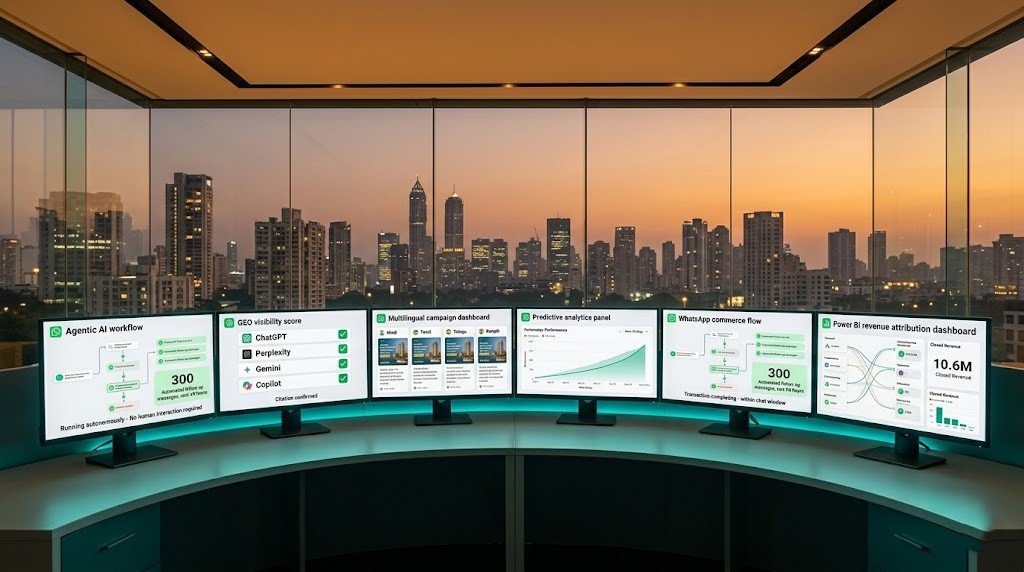
AI Marketing Trends India 2026: The Six Shifts Every Indian Business Needs to Act On Right Now
The most important AI marketing trends in India for 2026 are: agentic AI replacing manual campaign management with autonomous AI agents, GEO and AEO optimisation for ChatGPT and Google AI Overview visibility, vernacular and regional language content for tier-2 and tier-3 markets, AI-driven hyper-personalisation producing 40 percent of digital sales, WhatsApp commerce enabling transaction completion inside chat, and zero-party data collection replacing third-party cookies under India's DPDP Act. MarTech Union builds AI marketing systems around all six trends for businesses across India, UK, UAE and USA.
Introduction: India's Marketing Landscape Just Crossed a Tipping Point
The marketing world has crossed a tipping point. What began as experimental AI adoption in 2023 and 2024 has evolved into a strategic necessity in 2026. Nearly 90 percent of marketers now integrate AI into their processes in some form. Companies using AI in marketing see 22 percent higher ROI and 32 percent more conversions, and marketing teams using AI report 44 percent higher productivity, saving an average of 11 hours per week.
For Indian businesses, this is not a gradual shift. It is an accelerating divide.
The gap between businesses using artificial intelligence and those ignoring it is no longer a gap. It is a canyon. India is currently one of the fastest-growing digital economies in the world, with over 900 million internet users and a mobile-first population. AI has shifted from being a fancy add-on to the absolute operating system of modern marketing.
This guide covers the six AI marketing trends India 2026 that are actively reshaping how Indian businesses acquire customers, generate pipeline, and build brand authority. Every section is optimised for SEO, GEO, AEO, and voice search. Every trend comes with a specific action for Indian businesses to take this month.
Trend 1: Agentic AI — From Tools That Assist to Agents That Act
The single most important shift in AI marketing trends in India 2026 is the move from AI as a tool to AI as an agent.
Agentic AI is the big story among recent trends in digital marketing. These agents can think, plan, and execute. If a campaign is booming in Mumbai but struggling in Delhi, the technology shifts the budget on its own. It even designs a new ad version to better suit Delhi and emails you the results.
Until 2024, AI in Indian marketing meant using ChatGPT to write captions or Jasper to draft a blog post. A human still had to review, approve, launch, monitor, and adjust every single campaign element. AI was a productivity tool.
In 2026, agentic AI means an autonomous system that researches your ICP, writes the campaign brief, generates the creative variants, A/B tests them against each other, identifies the winner, scales budget toward it, pauses the underperformers, generates the weekly performance report, and recommends the next campaign direction. All of this happens without a human reviewing each step.
AI-driven campaigns launch 75 percent faster and generate 47 percent better click-through rates. The biggest gains typically come from AI-powered bid management, personalised content delivery, and predictive lead scoring, all areas that reduce inefficiency at scale.
For Indian businesses competing in high-CPL categories like B2B SaaS, real estate, and healthcare, agentic AI is not a future capability. It is a current competitive gap between businesses running traditional weekly-reviewed campaigns and those running continuously self-optimising systems.
Trend 2: GEO and AEO — The Search Landscape Has Split Into Four Channels
Generative Engine Optimisation (GEO) is now a primary trend: brands are optimising for AI-driven answers instead of just traditional search engine result pages to stay relevant and visible.
Over 65 percent of Google searches now end without a click because AI delivers the answer directly. Nearly 47 percent of all Google searches include a Google AI Overview above the traditional results. And 50 percent of B2B buyers use ChatGPT or Perplexity to shortlist vendors before visiting any website.
The AI marketing trends India 2026 landscape now has four distinct search channels that every Indian business must optimise for separately.
Traditional SEO earns rankings in Google's ten blue links. AEO earns position zero in featured snippets and voice assistant answers. GEO earns citations in ChatGPT, Perplexity, and Google Gemini AI-generated recommendations. And AIO uses machine learning to continuously audit and improve all three layers simultaneously.
Enter Generative SEO, the art of optimising for Google's Search Generative Experience and AI-powered query results. Instead of showing a list of links, Google now synthesises answers. Users ask a conversational question, and the AI gives them a context-rich response, often pulling from multiple sources at once.
For Indian businesses, GEO represents the largest untapped opportunity in AI marketing trends India 2026. Most competing businesses have not implemented GEO. Most agencies do not offer it as a genuine dedicated service. The first-mover window is still open in May 2026 and it is closing.
Trend 3: Vernacular and Regional Language Marketing
India's next 200 million internet users are coming primarily from Tier 2, Tier 3, and rural markets and they consume content primarily in their regional languages. Hindi, Tamil, Telugu, Kannada, Bengali, Marathi, and Gujarati content is growing dramatically faster than English content on every platform. Brands that create localised, vernacular content are seeing significantly higher engagement and conversion rates in these markets.
With over 68 percent of users already preferring native-language content, that share is expected to push into the 70 to 75 percent range by 2026. For Indian brands, this trend is not optional. It is about building trust and accessibility.
The AI marketing trends India 2026 opportunity in vernacular is compounded by two specific developments.
First, AI translation and localisation tools have matured enough that brands can produce genuine, culturally contextual regional language content at scale without the quality degradation that plagued early machine translation. The correct approach is not direct translation of English content but cultural adaptation that reflects the specific values, idioms, and reference points of the target regional audience.
For Indian businesses specifically, smart targeting and multilingual content levels the playing field. A small digital agency in Mumbai or a D2C brand in Pune can now access the same personalisation capabilities that only large corporations could afford five years ago.
Second, vernacular voice search is growing faster than any other search format in India. SEO strategies in 2026 must account for voice search patterns: conversational query structures, question-based content, and natural language rather than keyword-stuffed text. Brands optimising for vernacular voice search are capturing a high-intent audience that competitors ignoring this trend are missing entirely.
Trend 4: AI Hyper-Personalisation at Scale
Personalisation in 2026 is about knowing the context. AI now looks at intent signals in real time. According to Statista, by 2026, AI-driven personalisation will account for over 40 percent of all digital sales. It is about creating a unique path for every single person who visits your site.
Traditional personalisation was first-name-in-email and birthday discounts. AI hyper-personalisation in 2026 is serving a completely different homepage to a first-time visitor from Mumbai at 9 AM on a Tuesday versus a returning visitor from Bangalore at 8 PM on a Friday, based on their behaviour history, device, location, time signal, and predicted intent stage.
Brands that personalise their campaigns with AI are seeing two to three times higher conversion rates compared to one-size-fits-all strategies. AI analyses user behaviour across platforms, predicts which messages, visuals, and offers will work best, and personalises ads, emails, or website content in real time.
For Indian businesses managing multiple buyer segments across multiple cities, this real-time contextual personalisation is particularly powerful. The B2B SaaS founder in Bangalore searching for marketing automation and the D2C brand founder in Mumbai looking for customer acquisition tools may both land on the same MarTech Union service page. AI personalisation serves each a version of that page that reflects their specific context and need.
Trend 5: WhatsApp Commerce and Conversational Buying
India has over 500 million WhatsApp users. WhatsApp commerce is enabling transaction completion inside the chat window without any friction.
The AI marketing trends India 2026 shift in WhatsApp is from automation for lead follow-up to automation for complete transaction completion. Buyers in India can now discover a product through an Instagram ad, receive a WhatsApp message with product information and a payment link, and complete the purchase inside WhatsApp in under three minutes without visiting any website.
For B2B businesses, WhatsApp is now the full sales channel: lead qualification, demo booking, proposal sharing, contract review, and payment collection all happen within the WhatsApp conversation thread.
Shopping on social media has changed. Native checkouts on platforms like Instagram and YouTube mean there is zero friction. You see it, you like it, you tap your thumb, and it is yours. In India, this convergence of WhatsApp commerce and social commerce is creating the highest-conversion purchase journey available on mobile.
Trend 6: Zero-Party Data and DPDP-First Marketing
Zero-party data strategy is a key trend for 2026: marketers now collect data directly from users through quizzes and interactive polls to respect 2026 privacy laws. This allows brands to understand customer preferences without relying on third-party cookies that are increasingly blocked or restricted.
India's Digital Personal Data Protection Act is changing how Indian businesses collect and use marketing data. Third-party cookie-based targeting that drove Indian digital marketing for the past decade is being progressively restricted. The brands adapting to this shift by building first-party and zero-party data systems are gaining a compounding advantage over those still dependent on third-party data for targeting.
Zero-party data is data a customer shares intentionally: quiz responses, preference selections, account configurations, and direct feedback. It is more accurate than inferred behavioural data and fully compliant with India's DPDP Act.
How MarTech Union Applies Every AI Marketing Trend for Indian Businesses
MarTech Union builds AI marketing systems for businesses across India, UK, UAE and USA that incorporate all six of the AI marketing trends India 2026 identified in this guide.
Agentic AI runs our paid campaign optimisation continuously rather than on weekly review cycles. GEO and AEO optimisation is built into every content piece and service page as standard. Vernacular content strategy is available for Indian businesses targeting Hindi and regional language markets. AI personalisation is implemented through our CRM and marketing automation service. WhatsApp commerce and automation is a baseline component of every Indian marketing engagement. And every system we build is DPDP Act compliant from the first campaign brief.
We measure success by CPL, pipeline value, and revenue attributed to marketing. Not impressions. Not reach.
Book a free AI marketing audit at martechunion.com/contact.
Frequently Asked Questions (FAQs)
The six most important AI marketing trends in India for 2026 are: agentic AI replacing manual campaign management with autonomous AI agents that think, plan, and execute; GEO and AEO optimisation for ChatGPT and Google AI Overview visibility; vernacular and regional language content for tier-2 and tier-3 Indian markets where 68 percent of users prefer native-language content; AI hyper-personalisation accounting for 40 percent of digital sales; WhatsApp commerce enabling full transaction completion inside chat; and zero-party data strategy for DPDP Act compliant targeting. MarTech Union builds AI marketing systems around all six trends for Indian businesses.
Agentic AI in digital marketing refers to autonomous AI systems that can research, plan, create, launch, optimise, and report on marketing campaigns without requiring human approval at each step. Unlike AI tools that assist a human in completing a task, agentic AI completes the entire workflow independently. For Indian businesses, agentic AI matters because it eliminates the manual campaign management work that currently costs marketing teams an average of 11 hours per week. AI-driven campaigns launch 75 percent faster and generate 47 percent better click-through rates compared to manually managed campaigns.
GEO — Generative Engine Optimisation — structures website content, schema markup, and citations so AI platforms like ChatGPT, Perplexity, and Google Gemini recommend your business when buyers ask for recommendations. It is one of the top AI marketing trends in India for 2026 because over 65 percent of Google searches now end without a click and 50 percent of B2B buyers use AI to shortlist vendors before visiting any website. Most Indian businesses and agencies have not yet implemented GEO, creating a first-mover opportunity for businesses that act now. MarTech Union includes GEO in every AI marketing engagement.
AI personalisation in 2026 goes beyond first-name-in-email. It uses machine learning to analyse each visitor's behaviour history, device, location, time signal, and predicted intent stage and serves them a dynamically personalised version of landing pages, ad creative, email content, and product recommendations in real time. For Indian businesses managing multiple buyer segments across multiple cities and languages, AI personalisation ensures each buyer sees the most relevant version of every marketing touchpoint. AI-driven personalisation now accounts for over 40 percent of all digital sales, according to Statista.
Vernacular content is a key AI marketing trend in India for 2026 because over 68 percent of Indian internet users prefer native-language content, and India's next 200 million internet users are primarily from tier-2, tier-3, and rural markets where regional languages dominate. Hindi, Tamil, Telugu, Kannada, Bengali, Marathi, and Gujarati content is growing faster than English on every Indian platform. AI translation and localisation tools have matured enough to produce culturally contextual regional language content at scale. Brands creating vernacular content consistently see higher engagement and conversion rates than English-only campaigns in these markets.
WhatsApp commerce is transforming digital marketing in India by enabling complete transaction journeys inside the chat window without any website visit. Buyers discover a product through an ad, receive a WhatsApp message with product information and a payment link, and complete the purchase inside WhatsApp in under three minutes. India has over 600 million WhatsApp users and the platform is the primary communication channel for both consumer and B2B transactions. AI-powered WhatsApp agents handle product queries, qualification, booking, proposal sharing, and payment collection automatically.
Zero-party data is data customers share intentionally through quizzes, preference selections, account configurations, and direct feedback. It is more accurate than inferred behavioural data and fully compliant with India's Digital Personal Data Protection Act, which restricts third-party cookie-based targeting. For Indian businesses running AI marketing in 2026, zero-party data is the foundation of compliant, precise personalisation as third-party data sources become progressively unavailable. Brands collecting zero-party data through interactive content, lead magnets, and onboarding flows are building a sustainable targeting advantage.
India's Digital Personal Data Protection Act requires explicit consent before using personal data for AI targeting, user rights to data deletion, and privacy-first data handling throughout all marketing systems. For Indian businesses, this means: all lead capture forms must include DPDP-compliant consent language, all WhatsApp automation must use verified opt-in contacts, all AI targeting must be built on first-party or zero-party data rather than inferred third-party signals, and all customer data must be deletable on request. AI marketing systems built on first-party data foundations are both more DPDP-compliant and more accurate than those dependent on third-party cookies.
Indian businesses are using several categories of AI marketing tools across the six major trends. For agentic AI and campaign automation: Google Performance Max, Meta Advantage Plus, and custom n8n and Make workflow agents. For GEO and AEO: Surfer SEO, Semrush's AI content audit, and Schema Pro for JSON-LD implementation. For personalisation: HubSpot Smart Content, Optimizely, and Salesforce Einstein. For content at scale: ChatGPT, Claude, and Gemini as first-draft tools with human expert review. For WhatsApp commerce: WhatsApp Business API with Wati, Interakt, or custom automation. For analytics: Power BI and Looker Studio connected to AI attribution models.
AI marketing investment for Indian businesses ranges widely by scope. An entry-level AI marketing programme covering agentic paid campaign management, basic GEO implementation, and WhatsApp automation starts at INR 25,000 to INR 50,000 per month in agency fees. A full-stack AI marketing system covering agentic AI, GEO, and AEO, vernacular content, AI personalisation, WhatsApp commerce, and DPDP-compliant first-party data architecture runs INR 75,000 to INR 2,50,000 per month. The correct evaluation is not the monthly cost but the ROI: companies using AI in marketing consistently see 22 percent higher ROI and 32 percent more conversions.
Agentic AI campaign optimisation shows CPL improvement within 30 to 60 days as machine learning models collect data and identify the highest-performing combinations. GEO citations in ChatGPT and Google AI Overviews appear within 60 to 90 days of content restructuring and schema markup. Vernacular content produces measurable engagement improvement within 30 days of the first language-optimised campaign. AI personalisation shows conversion rate improvement within two to four weeks of first implementation. WhatsApp commerce automation shows immediate improvement in response rates from day one of deployment.
AI marketing is accessible for Indian SMEs and startups in 2026. 64 percent of Indian SMBs report that AI has levelled the playing field, allowing them to access personalisation and automation capabilities that previously required enterprise budgets. Entry-level agentic AI tools like Google Performance Max and Meta Advantage Plus are available to any business running paid campaigns regardless of budget size. WhatsApp Business API automation starts at a minimal monthly cost. Basic GEO and AEO implementation costs primarily in time and expertise rather than ongoing spend. MarTech Union offers AI marketing packages for Indian SMEs and startups from INR 25,000 per month.
Traditional SEO earns rankings in Google's conventional ten blue links through keyword optimisation, backlinks, and technical performance. GEO earns citations inside AI-generated responses from ChatGPT, Perplexity, and Google Gemini through content structured for AI extraction, schema markup, and authoritative third-party citations. As an AI marketing trend India 2026, GEO matters because it targets the growing share of buyer research that starts on AI platforms rather than Google search. The two disciplines use different signals and require separate implementation. Businesses that invest in both reach buyers across the full spectrum of how they now discover vendors.
GEO is the most underused AI marketing trend among Indian businesses in 2026. Despite 50 percent of B2B buyers using AI platforms to shortlist vendors and Gartner projecting 25 percent of Google search traffic will shift to AI chatbots by end of 2026, most Indian businesses have zero GEO visibility. Their Google Business Profile is optimised. Their Google Ads are running. Their content is ranking on page one. But they are invisible in ChatGPT and Google AI Overviews for their most important buyer queries. GEO is the first-mover opportunity that most Indian businesses are not yet aware of and most Indian agencies are not yet offering as a genuine service.
MarTech Union is an AI-powered digital marketing agency serving businesses across India, UK, UAE and USA that builds complete AI marketing systems incorporating all six major AI marketing trends India 2026: agentic AI for continuous campaign optimisation, GEO and AEO for AI search visibility, vernacular content for regional Indian markets, AI personalisation, WhatsApp automation and commerce, and DPDP-compliant first-party data architecture. We measure success by CPL, pipeline value, and revenue attributed to marketing. Book a free AI marketing audit at martechunion.com/contact.